
For the days it’s pouring, too cold, or you just don’t feel like wrangling coats and shoes — these indoor activities for grandkids will actually hold their attention without you needing to run to the store first.
Sock Puppet Theater
Ages 4–9 · 20 min make + play · Low mess
Grab a few old socks, googly eyes or buttons, and a marker, and let them build a character. Once the puppets are done, drape a blanket over the back of a couch as a “stage” and put on a show — I always end up playing at least three characters myself.
You’ll need: old socks, buttons or googly eyes, glue or a needle and thread, a marker for details.
Why it works: Building a character and then having to “become” it for a show is real imaginative play — and honestly, it’s a good excuse for you to get a little dramatic too. Don’t hold back on the voices.
Indoor Scavenger Hunt
Ages 3–9 · 15–20 min · No supplies
Write (or just call out) a list of things to find — “something soft,” “something that starts with B,” “something round.” Send them off room to room to hunt. No prep beyond a scrap of paper, and it burns a genuinely impressive amount of energy for an indoor activity.
You’ll need: paper and a pen, or nothing at all if you just call out clues one at a time.
Why it works: This one flexes with age better than almost anything on this list — categories (“something starts with…”) for an older kid, simple objects for a younger one, all running at once if you’ve got a mixed-age group.
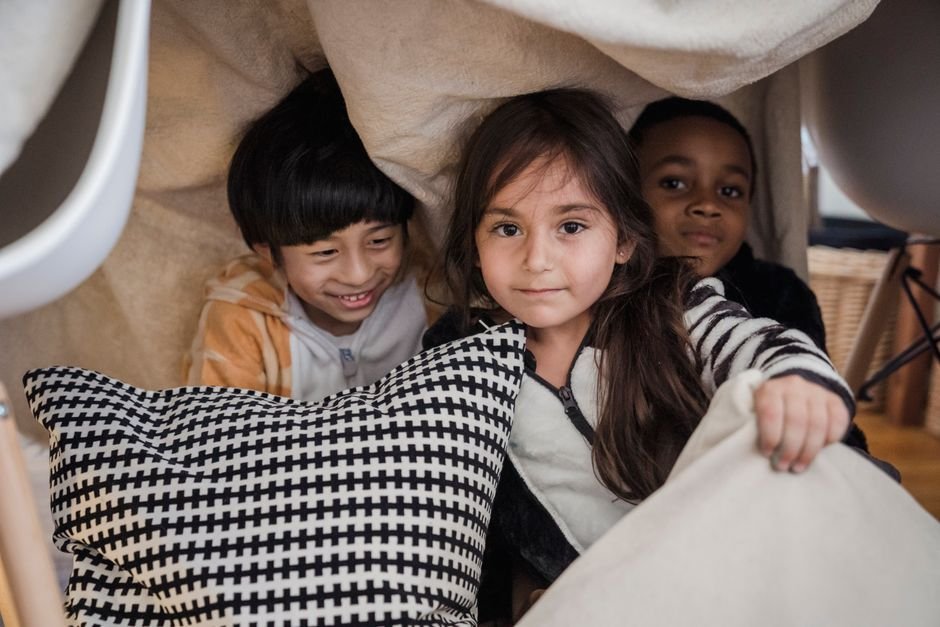
Blanket Fort Building
Ages 2–10 · 15–30 min · No mess
Couch cushions, chairs, and every blanket in the house. I let them direct the whole build — where the “door” goes, whether it’s a castle or a spaceship — and then we read a book in there with a flashlight once it’s done.
You’ll need: blankets, couch cushions, chairs, a flashlight if you want to add the “reading inside” step.
Why it works: Letting them direct the build instead of doing it for them is the whole point — it turns into problem-solving (how do we make the roof stay up?) disguised as play.
Freeze Dance
Ages 2–7 · 10–15 min · No mess
Put on music, dance around like nobody’s watching, and freeze the second it stops. I go all-in on the silly dancing — the sillier I get, the harder they laugh, and the more they want another round.
You’ll need: any music you can pause — a phone or speaker is plenty.
Why it works: It’s listening practice disguised as chaos — they have to actually pay attention to the music to catch the exact moment it stops.
Indoor Bowling
Ages 3–8 · 10–15 min · Low mess
Line up empty water bottles or plastic cups at the end of a hallway and roll a soft ball at them. Simple as it sounds, and it’s held attention longer than I expected every single time we’ve done it.
You’ll need: 6–10 empty bottles or cups, a soft ball (a rolled-up pair of socks works in a pinch).
Why it works: Rolling underhand and aiming is real hand-eye coordination practice, and taking turns setting the pins back up adds a little responsibility to the fun.
All five of these get pulled out on our worst-weather days — if you try one and it flops, tell me and I’ll swap it for something better.
Want more? Check out Crafts for hands-on projects, or Learning for activities by age and stage. For even more indoor inspiration, PBS Parents has a solid collection too.